
It’s not every day you come across something in nature that makes you question what you’re seeing. For many, stumbling upon what appears to be a piece of copper wire in a puddle only to have it start moving and twisting is a bewildering experience. This unexpected encounter often raises the question: what exactly is it that you’re looking at?
While many might dismiss it as a curious phenomenon of the natural world, those who dig a little deeper will find that this ‘copper wire’ is actually a living organism, specifically a type of parasite known as the horsehair worm. This peculiar creature’s ability to contort and knot itself is as fascinating as it is unsettling, leading many to wonder about its origins, habits, and whether it poses any danger to humans.
1. The Startling Moment: When a ‘Copper Wire’ Came to Life
Imagine the scene: you’re walking along a path after a rainy day, and a small puddle catches your eye. Something thin, rigid, and metallic-looking lies within. Out of idle curiosity, you lean in for a closer look, perhaps nudging it with a stick, when suddenly the object begins to move. What you thought was an inanimate object is now writhing and twisting in a display that’s both fascinating and a bit unnerving.
This moment of realization is common among those who encounter horsehair worms for the first time. Typically ranging from 4 to 14 inches in length and as thin as a single strand of hair, these creatures are often mistaken for debris or human-made materials until they begin their characteristic movements.
2. First Clues: Why Its Thin, Stiff Body Is So Unusual
The first clue to understanding this creature lies in its physical structure. Horsehair worms have a unique body composition that allows them to appear both stiff and flexible at different points in time. Their bodies are covered with a tough, cuticular layer that grants them a wiry appearance, often leading to comparisons with horsehair or copper wire.
Their incredible thinness, often just a fraction of a millimeter in diameter, adds to the illusion of rigidity. However, this same structure is what enables them to perform intricate movements, knotting themselves in seemingly impossible ways, a behavior that serves multiple purposes in their life cycle.
3. Not a Worm in Your Gut: What Horsehair Worms Actually Are
Despite their worm-like appearance, horsehair worms are not true worms but belong to their own phylum, Nematomorpha. They are parasitic in nature, but not in the way that might immediately come to mind, such as the parasitic worms that infect humans and animals.
Horsehair worms are primarily parasitic during their larval stage, typically infecting insects like crickets and grasshoppers. Once they mature and exit their host, they become free-living in aquatic environments, where they are commonly found by unsuspecting humans.
4. How Horsehair Worms Move, Knot, And Twist Themselves
The movement of horsehair worms is both mesmerizing and slightly disconcerting. They exhibit a unique form of locomotion that involves twisting, coiling, and knotting their bodies. This behavior is not just a random display; it plays a role in their mating rituals and is a method of locomotion in the aquatic environments they inhabit.
The twisting and knotting can help them navigate through the water, and in some cases, these movements can even aid in attracting mates. Their ability to tie themselves in knots is facilitated by their slender, flexible bodies, allowing them to maneuver in ways that seem otherworldly.
5. From Crickets to Puddles: The Bizarre Life Cycle of Horsehair Worms
The life cycle of a horsehair worm is a tale of transformation and adaptation. Beginning as microscopic larvae, they must find a suitable host, typically an insect such as a cricket or grasshopper. Once inside, they absorb nutrients from their host, growing and developing until they reach maturity.
When the time comes, the mature worm compels its host to seek out water, often leading to the host’s demise as the worm exits its body to continue its life in an aquatic environment. This remarkable life cycle is a testament to their adaptability and the complex interactions between parasite and host.
6. Where They Live: Common Habitats and When You’re Likely to See One
Horsehair worms are most commonly found in freshwater environments, including streams, ponds, and even temporary puddles following heavy rains. They thrive in moist conditions, which is why they are often encountered in areas with recent rainfall.
While they can be found across the globe, they are more frequently observed in temperate regions. Their presence in shallow waters and near the edges of water bodies makes them more noticeable to those who venture into these areas.
7. Is It Dangerous? What Horsehair Worms Can (And Can’t) Do to Humans
One of the most pressing questions for anyone encountering a horsehair worm is whether it poses any danger. Fortunately, horsehair worms are harmless to humans and other vertebrates. They do not infect humans or pets, and their parasitic nature is limited to specific insect hosts.
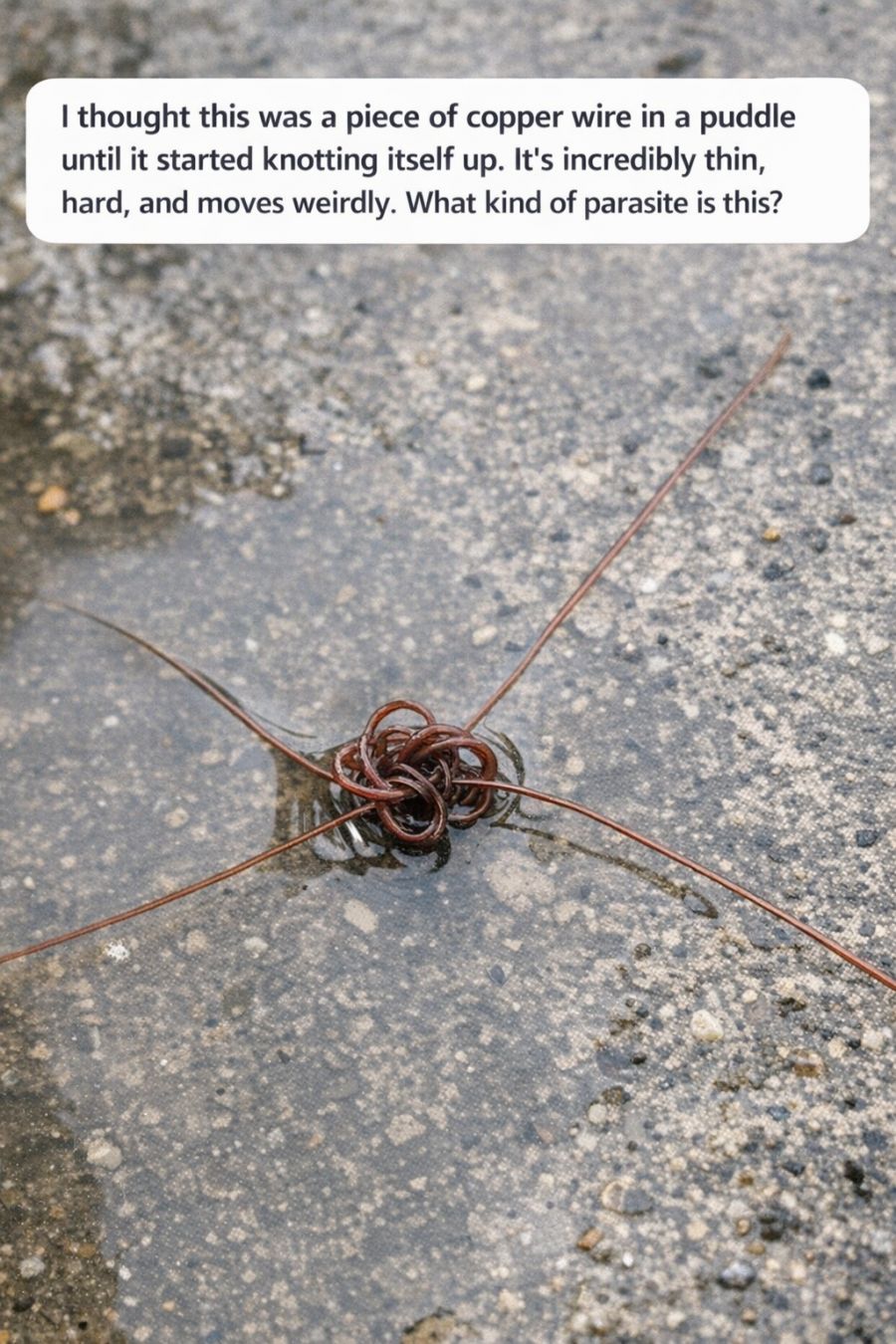
I thought this was a piece of copper wire in a puddle until it started knotting itself up. It’s incredibly thin, hard, and moves weirdly. What kind of parasite is this?
Pages: 1 2
